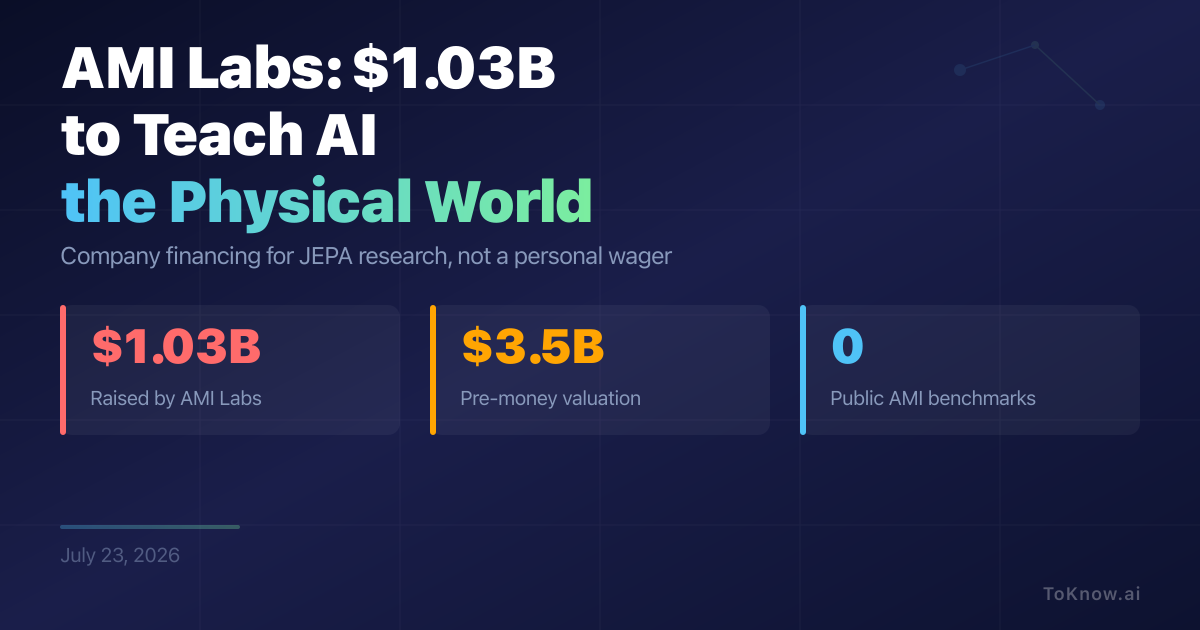
AMI Labs, the company founded by Yann LeCun, raised $1.03 billion at a $3.5 billion pre-money valuation to build AI systems that reason and plan with real-world data. This is company financing, not LeCun personally staking $1 billion against language models. AMI’s planned world models use Joint Embedding Predictive Architectures (JEPA): instead of predicting every pixel, they learn compact representations of video and sensor data, then predict how those representations change after an action. LeCun still calls language models extremely useful for text, research, and code and expects them to orchestrate larger systems. His claim is narrower: next-token prediction alone cannot give a robot enough physical understanding to plan reliably. “Chinchilla epiphany” is the wrong label too. Chinchilla studied how to balance model size and training data; JEPA changes what a model predicts.
The round funds a test of whether abstract prediction can make AI more reliable in factories, vehicles, robotics, and healthcare. Meta has shown related results, but they do not come from AMI: its 1.2-billion-parameter V-JEPA 2 used more than 1 million hours of video, then 62 hours of robot data, and reported 65% to 80% success on pick-and-place tasks with unseen objects and settings. AMI itself has published no product, technical report, or benchmark as of July 23. Investors have funded a research direction, not validated a commercial result. AMI now has to show that JEPA-style planning can become dependable on matched real-world tasks.
Sources:
- AMI Labs launch update
- Reuters funding report
- MIT Technology Review interview with Yann LeCun
- Meta V-JEPA 2 announcement and benchmarks
- Chinchilla paper
Disclaimer: For information only. Accuracy or completeness not guaranteed. Illegal use prohibited. Not professional advice or solicitation. Read more: /terms-of-service
Reuse
Citation
@misc{kabui2026,
  author = {{Kabui, Charles}},
  title = {AMI {Labs:} {\$1.03B} to {Teach} {AI} the {Physical} {World}},
  date = {2026-07-23},
  url = {https://toknow.ai/posts/ami-labs-1-billion-world-models-physical-ai/},
  langid = {en-GB}
}