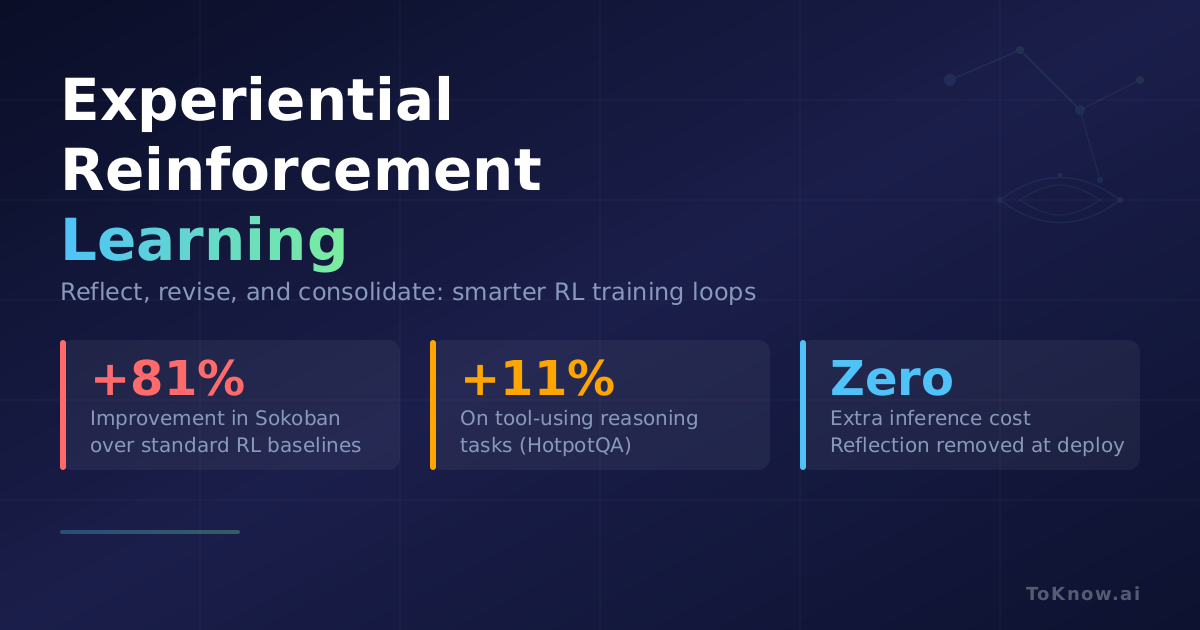
Researchers at USC and Microsoft introduce Experiential Reinforcement Learning (ERL), which adds a structured loop to how language models learn from feedback. Standard RL gives the model a task, observes whether it succeeded or failed, and adjusts weights based on a single numerical score. The problem: in real-world tasks, feedback is sparse and delayed, so the model must implicitly figure out what went wrong. ERL makes this explicit. The model generates an initial attempt, receives environmental feedback, then produces a written reflection analyzing what happened. That reflection guides a second, refined attempt. If the second attempt succeeds, the successful sequence of actions is reinforced and consolidated into the model’s default behavior. At deployment time, the reflection loop is removed, so there is no additional inference cost. Across sparse-reward control environments, ERL achieves up to 81% improvement over standard RL baselines. On agentic reasoning benchmarks involving tool use, gains reach 11%.
The value is in learning efficiency. AI agents operating in complex environments (coding, web browsing, multi-step research) frequently encounter sparse rewards where success or failure only becomes clear after many steps. Traditional RL struggles here because the signal is too weak to guide exploration effectively. ERL converts vague failure signals into structured behavioral revisions. This means fewer training samples needed to reach the same performance level, which directly reduces GPU hours and cost. The approach works with any model and acts as a wrapper around existing RL setups.
This represents a conceptual shift: instead of learning from rewards alone, models learn from experience. The distinction matters as RL becomes the dominant fine-tuning method for frontier models. Smarter training loops, not just more compute, may be the faster path to capable agents.
Sources:
- ERL Paper (arXiv:2602.13949)
- ERL on Hugging Face Papers (#1 Paper, Feb 17)
- Author’s X Thread (Taiwei Shi)
- Reflexion: Language Agents with Verbal Reinforcement Learning
- Kolb’s Experiential Learning Theory
Disclaimer: For information only. Accuracy or completeness not guaranteed. Illegal use prohibited. Not professional advice or solicitation. Read more: /terms-of-service
Reuse
Citation
@misc{kabui2026,
  author = {{Kabui, Charles}},
  title = {Experiential {Reinforcement} {Learning:} {Microsoft’s}
    {Reflection} {Loop} {Boosts} {RL} {Efficiency} by 81\%},
  date = {2026-03-04},
  url = {https://toknow.ai/posts/experiential-reinforcement-learning-microsoft-reflection-loop/},
  langid = {en-GB}
}