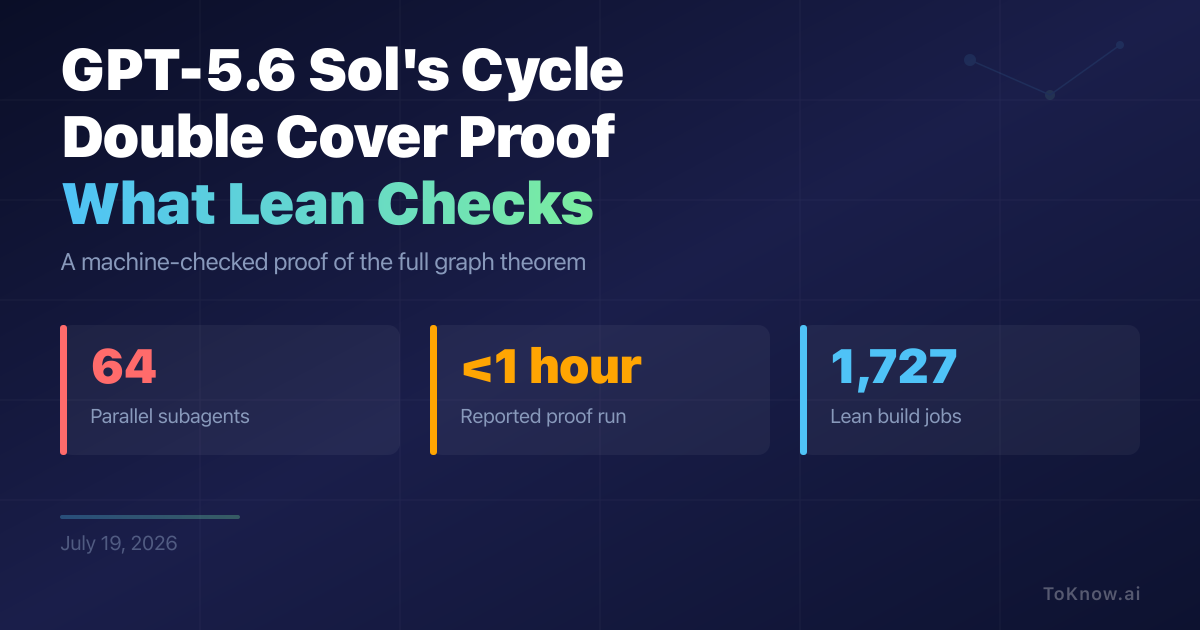
OpenAI says GPT-5.6 Sol Ultra used 64 subagents in just under one hour to produce a three-page proof of the Cycle Double Cover Conjecture. The conjecture asks whether every finite graph without a bridge, an edge whose removal disconnects the graph, has cycles that cover each edge exactly twice. The proof first reduces the problem to cubic graphs, where every vertex has three edges. It then uses the Jaeger-Kilpatrick eight-flow theorem to label edges with nonzero values from a group of eight elements. A short linear algebra argument turns those labels into the required cycles. Graph theorist Thomas Bloom called it “a very nice proof”.
The stronger correctness check is a separate 7,224-line Lean formalization. Lean’s small trusted kernel checks every proof step against the stated definitions. OpenAI’s verification record reports 1,727 build jobs, no warnings, no unfinished sorry or admit placeholders, and no project-specific axioms. Its final theorem covers finite loopless bridgeless multigraphs, including parallel edges. That verifies the formal statement encoded in Lean. It does not show that the formalization was created during the one-hour run, and mathematicians must still inspect whether its definitions match the conventional conjecture. This is why machine-checked source matters: readers can audit more than polished prose.
Read More: OpenAI’s Reasoning Model Disproves a 1946 Erdős Conjecture in Geometry
Sources:
- OpenAI’s proof
- OpenAI’s full prompt
- Lean verification record
- Final Lean theorem
- Thomas Bloom’s proof commentary
Disclaimer: For information only. Accuracy or completeness not guaranteed. Illegal use prohibited. Not professional advice or solicitation. Read more: /terms-of-service
Reuse
Citation
@misc{kabui2026,
  author = {{Kabui, Charles}},
  title = {GPT-5.6 {Sol’s} {Cycle} {Double} {Cover} {Proof:} {What}
    {Lean} {Actually} {Checks}},
  date = {2026-07-19},
  url = {https://toknow.ai/posts/gpt-56-sol-cycle-double-cover-lean-proof/},
  langid = {en-GB}
}