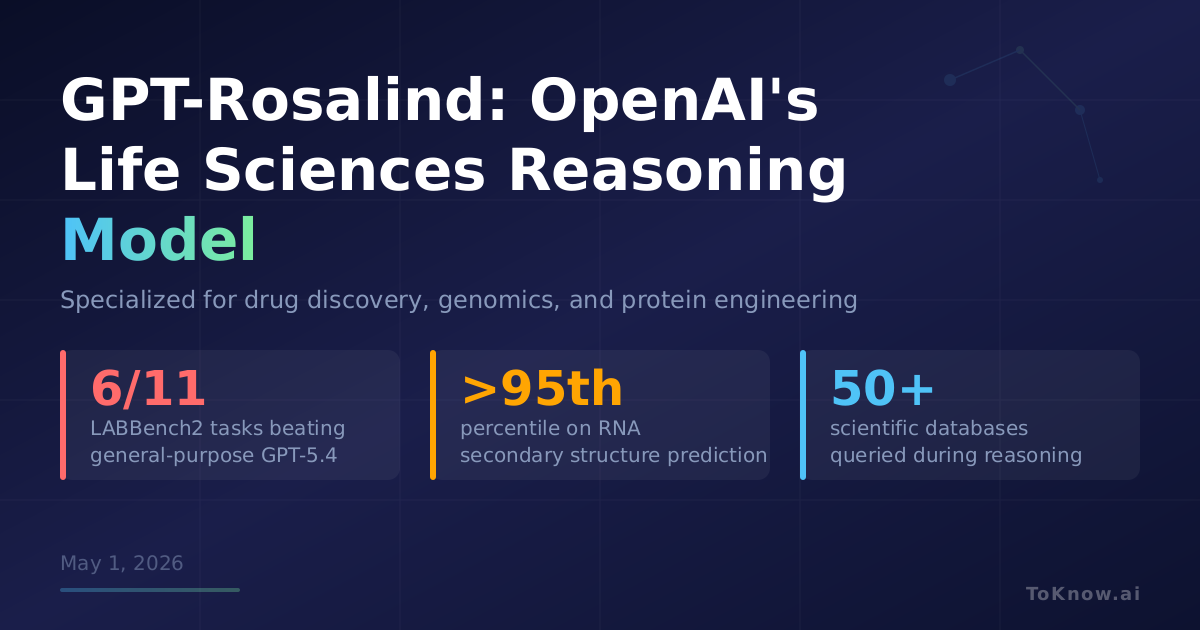
OpenAI released GPT-Rosalind, a reasoning model specialized for life sciences: chemistry, genomics, protein engineering, and drug discovery. Named after Rosalind Franklin, whose X-ray crystallography was central to discovering DNA’s structure. On LABBench2 (a benchmark covering molecular property prediction, protein function annotation, genomic variant interpretation, and chemical reaction prediction), GPT-Rosalind outperforms GPT-5.4 on 6 of 11 tasks. It scores above the 95th percentile on RNA secondary structure prediction, a task core to mRNA therapeutics like vaccines and gene therapies. The model integrates 50+ scientific databases (PubMed, UniProt, PDB, ChEMBL) and can query them mid-reasoning rather than relying solely on training data. OpenAI partnered with Amgen for drug target identification, Moderna for mRNA sequence design, and the Allen Institute for Cell Science for cellular biology research. Academic researchers get free access through a Codex plugin.
The practical value: a pharmaceutical researcher designing an mRNA therapeutic can now get RNA folding predictions at expert-level accuracy through an API, rather than running expensive wet-lab experiments or waiting for specialized compute clusters. Moderna’s integration means this is already in a production drug design pipeline, not a research demo. The free academic Codex plugin puts frontier biology AI in the hands of university labs that could never afford proprietary tools.
This is OpenAI’s first domain-specialized reasoning model, a departure from the “one general model” strategy. Beating GPT-5.4 on majority of domain tasks confirms that specialization still yields gains even at frontier scale. If this pattern holds, expect similar vertical models for materials science, climate modeling, and legal reasoning. OpenAI previously released Prism for scientific writing, but GPT-Rosalind goes deeper: it reasons about molecular structures, not just text.
Sources:
- Introducing GPT‑Rosalind for life sciences research
- LABBench: Measuring LLM Abilities in Biology (arXiv)
- OpenAI launches AI model GPT-Rosalind for life sciences research
Disclaimer: For information only. Accuracy or completeness not guaranteed. Illegal use prohibited. Not professional advice or solicitation. Read more: /terms-of-service
Reuse
Citation
@misc{kabui2026,
  author = {{Kabui, Charles}},
  title = {GPT-Rosalind: {OpenAI’s} {Specialized} {Model} for {Life}
    {Sciences} and {Drug} {Discovery}},
  date = {2026-05-01},
  url = {https://toknow.ai/posts/gpt-rosalind-openai-life-sciences-reasoning-model-drug-discovery/},
  langid = {en-GB}
}