Introduction
Health insurance debates in Kenya often stop at one question: are you covered? The harder question is what happens when that cover reaches a limit, rejects a claim or lapses before treatment begins.
Every health plan has boundaries. It pays for listed services up to stated limits, provided that contributions are current, the facility is approved and the patient is registered. Once a claim crosses one of those boundaries, the patient or hospital must cover the difference. Most of those boundaries are written into the law, regulations or policy schedule.
In March 2026, the High Court found that the nationwide rollout of the Social Health Insurance Fund (SHIF) on 1 October 2024 was “manifestly unreasonable”. In Okoiti and 2 others v Cabinet Secretary, Ministry of Health, the court said patients were “immediately denied critical services, including dialysis and cancer treatment”. It also noted SHA’s admission that some exempt patients had been denied services and forced to pay cash. The court found “real, preventable harm, resulting in suffering and, in some cases, loss of life”. It did not dismantle SHIF. Instead, it ordered corrective action and quarterly progress reports for one year.
This article examines the mechanics behind those failures: caps, sub-limits, waiting periods, lapses, referral restrictions, delayed claims and the separate medical scheme retained for public officers.
1. Annual limits leave part of the bill unpaid
SHIF pays for listed treatment up to specified limits. Regulation 63(e) of the Social Health Insurance Regulations excludes “all costs by which the annual limits of a beneficiary in respect of the relevant healthcare services are exceeded, for any treatment”.
Regulation 32(3)(i) requires a hospital to warn the patient and SHA when a financial limit is nearly exhausted. The hospital may not withhold accident or emergency treatment for financial reasons. Treatment can therefore continue after the limit is reached, but the regulation does not say who must settle the excess.
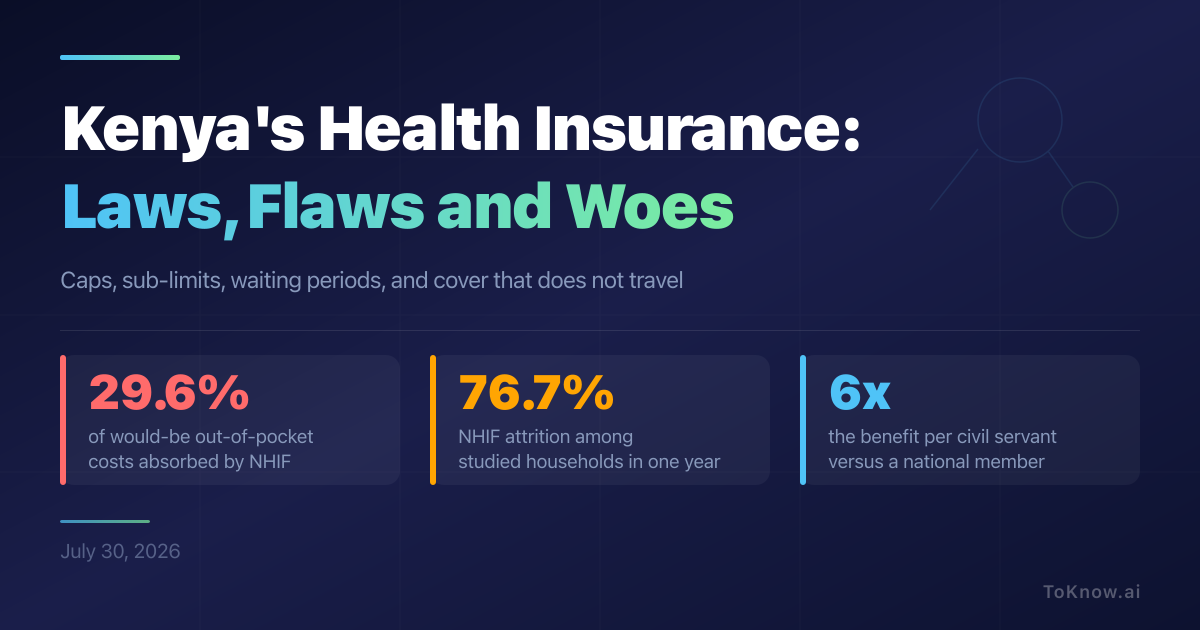
A 2023 study of households affected by hypertension or diabetes found that active National Health Insurance Fund (NHIF) cover absorbed 29.6% of the healthcare costs that members would otherwise have paid out of pocket (Oyando et al., 2023). Insured households spent 12.4% of their budgets on healthcare, compared with 23.2% among uninsured households. Even so, the study found no strong evidence that NHIF protected enrolled households from catastrophic health expenditure.
A 2025 analysis of Nairobi Cancer Registry data found that the NHIF oncology benefits package produced no statistically significant change in the time taken to start treatment (Gakunga et al., 2025). In its review of earlier Kenyan research, the paper notes first-year breast and cervical cancer costs of up to USD 12,000 and a study in which 81% of cancer patients at three treatment centres borrowed money for care. Those two figures come from studies cited by Gakunga and colleagues, not from their own registry analysis.
When a bill exceeds the available cover, the consequences can become extreme. In a June 2025 judgment, the High Court considered the case of a premature baby who remained in hospital after medical discharge until a court ordered the baby’s release on 8 July 2024. The court reaffirmed that detaining a patient over an unpaid bill is unlawful, arbitrary and unconstitutional. It nevertheless dismissed the petition because the evidence did not establish the mother’s constitutional claims against the hospital. The detention was wrong, but the petitioner did not prove the rest of her case.
Caps help an insurance fund control costs. The policy failure is leaving patients without a stated maximum exposure or a clear mechanism for settling the gap.
2. Some conditions have much lower limits
The overall limit rarely tells the whole story. Policies also carry inner limits for particular treatments. A condition can therefore be covered in principle but severely restricted in practice.
Mental health cover illustrates the problem. Section 3D of the Mental Health Act gives people with mental illness access to public and private medical insurance. Discrimination when obtaining cover can attract a fine of up to KSh 5 million, imprisonment for up to three years, or both. The law does not, however, require mental health benefits to have the same limits, co-payments or treatment conditions as physical healthcare.
The SHIF regulations acknowledge this problem in substance-use treatment. The Fourth Schedule places “Drug and Substance Abuse Rehabilitative services above the SHIF limit” under the Emergency, Chronic and Critical Illness Fund. The wording anticipates that the main SHIF benefit can run out before rehabilitation ends.
Kenya has legislated access to mental health insurance without requiring equal benefit limits.
The United States’ Mental Health Parity and Addiction Equity Act requires financial limits and treatment restrictions for mental health and substance-use disorder benefits to be no more restrictive than those for medical and surgical care. Kenya could adopt that rule without copying the American financing system. Insurers should also have to publish comparisons between mental and physical health limits, together with complaint outcomes. Provider lists need auditing too. A 2023 secret-shopper study secured an appointment through one New York insurer’s psychiatry directory in only 3.1% of calls.
3. Cover can lapse before treatment begins
Section 27(4) of the Social Health Insurance Act allows access only where contributions “are up to date and active”. Section 27(6) adds a penalty of 2% of the amount due for the period it stays unpaid. Section 27(7) closes the door: a person “shall pay all outstanding contributions and penalties accrued before resuming access”. Fall behind while sick, and the scheme’s answer is a bill you must clear before it will help you with the bill you cannot clear.
Salaried workers may lose access because of a deadline they do not control. Parliament’s December 2025 review of ten facilities recorded public servants paying cash after employers failed to remit their premiums by the ninth day of the month. In March 2026, the Employment and Labour Relations Court issued a temporary injunction in Mweresa and 2 others v Social Health Authority. The order stopped SHA from interrupting services on the tenth day where an employer had deducted the contribution but had not yet remitted it. The court found a prima facie threat to the rights to health and dignity, then referred the petition to the Chief Justice for appointment of a three-judge bench. The underlying constitutional dispute remains unresolved.
Waiting periods delay access at the start of cover. Under the SHIF regulations, regulation 12(4) makes an additional spouse eligible fourteen days after declaration and payment. Regulation 14(3)(a) applies the same period to a newly declared spouse, while regulation 14(3)(b) covers a child from the date of the amendment. Kenya therefore already regulates some waiting periods under SHIF, but it sets no equivalent statutory maximum for private medical policies.
Continuity is another problem. In the 2023 study of households affected by hypertension or diabetes, only 10.9% maintained active NHIF enrolment throughout the four survey waves. The authors reported an attrition rate of 76.7% over one year.
The contribution cut-off is written into the Act. Applying it to an employee whose employer already deducted the money was an additional administrative choice.
A grace period and repayment plan would protect members from immediate loss of cover. Employees should not lose access because an employer remits late. Contributions for households with irregular income also need a payment schedule that reflects how those households earn. Rwanda’s move from a flat premium to stratified rates made contributions less regressive, although researchers still recommended more subsidies for vulnerable households (Chirwa et al., 2021). A 2023 study of digital financial services in Kenya and Rwanda found that mobile payment systems contributed to health-system performance and probably increased insurance coverage (Wilson et al., 2023).
4. Cover does not always follow the patient
Under NHIF, members had to nominate a contracted outpatient facility before they could use the benefit. A 2023 qualitative study found the number of alternative facilities was widely seen as inadequate, and that rural members, unlike urban ones, often did not understand how to choose or change a provider. The benefit was national. Reaching it depended on where you lived.
SHIF retained a referral gate. Under the SHIF regulations, regulation 7(2) routes facility-based primary care through an empanelled level 2, level 3 or designated level 4 facility. Regulation 63(c) bars payment for claims arising from “any unauthorised referrals”. Emergency treatment is different: regulation 27(4) of the regulations, which is separate from section 27(4) of the Act, makes it available to every person.
Parliament found the referral portal unavailable, “preventing patients from being traced through the system as referral cases from primary facilities, undermining the continuum of care”. It also found that SHIF did not cover outpatient services at level 5 hospitals. The committee recommended activating the portal and extending covered outpatient care to those facilities.
The Digital Health Act is explicit about records. Section 6(d) requires “a system of shareable and portable personal health records”, section 6(e) requires health-data portability, and section 36 gives a person the right to examine and receive a copy of their health information. Those rights have limited value when the referral system cannot trace the patient’s journey.
Kenya corrected one transition problem. Regulation 13(1) originally required NHIF members to register afresh. Legal Notice 55 of 2025 replaced that requirement with automatic transition after SHA verifies a member’s data against government databases.
Australia’s portability rule states that a person moving to the same or a lower level of benefit does not have to serve the same waiting periods again. Kenya could require similar credit for continuous prior cover. SHA should also publish a clear procedure for changing a primary facility, make referral rejections appealable, and allow chronic-illness refills and follow-up visits when members are away from their usual facility.
5. Public officers retain a separate medical scheme
SHIF was presented as the national route to universal health coverage, yet public officers retained a separate medical scheme with more generous benefits.
The Comprehensive Medical Insurance Scheme for Civil Servants and Disciplined Services began in 2012 and was managed separately within NHIF. Barasa and colleagues found that per-capita benefits paid for members of the civil servants scheme were six times those paid for members of the national scheme, USD 60 compared with USD 11 (Barasa et al., 2018). The paper also cites evidence that hospitals created and staffed special civil-servant clinics at the expense of other services, and sometimes allowed civil servants to jump queues. Some informal-sector workers reportedly saw that preferential treatment as a reason not to enrol in NHIF.
SHA’s arrival did not merge that scheme into the standard national package. The Public Finance Management (Public Officers Medical Scheme Fund) Regulations, Legal Notice 195 of 2024, created a separate fund financed through parliamentary appropriations and contributions from public-service employers, the Teachers Service Commission and the National Police Service Commission. Regulation 12(1) makes the Chief Executive Officer of SHA its administrator. Regulation 14(2)(c) requires annual contracts to provide “a benefits package equivalent or higher to the Comprehensive Medical Insurance Scheme for Civil Servants accessed by Civil Servants immediately before the commencement of these Regulations”.
The same authority therefore administers both SHIF and a separate fund whose benefits cannot fall below the previous civil-service package. The regulations treat this additional cover as an employment benefit for public officers. They do not explain why the standard SHIF package is insufficient for that group but sufficient for everyone else.
That arrangement fragments the risk pool and creates a visible difference between the cover offered to public officers and the cover available to ordinary members.
A comparative study of South Korea, Turkey, Thailand and Indonesia found that equity was a main reason for merging health-insurance funds. The most common obstacle was resistance from groups with better benefits (Bazyar et al., 2021). Turkey began merging schemes in October 2008 and transferred active civil servants in January 2010. Out-of-pocket spending later fell to about 19% of health costs. Over the same period, health spending rose from 5.4% to 6.7% of GDP, and duplicate enrolments made coverage figures unreliable. Indonesia folded Askes, its civil-servant scheme, into BPJS Health in January 2014. Coverage reached about 76% by 2018, but many informal workers remained outside the scheme.
Thailand took a different route. Its 2002 universal-coverage reform left the Civil Servant Medical Benefit Scheme under the Ministry of Finance. The comparative study reports “quadruple per capita expenditures in CSMBS compared to UCS”. Kenya is following a similar two-tier structure.
At a minimum, Kenya should publish annual per-capita benefits paid under SHIF and the Public Officers Medical Scheme Fund in the same table. That would show whether the sixfold gap documented under NHIF has narrowed or persisted.
6. Private medical benefits have few statutory rules
The Insurance Act regulates licensing, solvency and market conduct, but it does not prescribe medical-policy waiting periods, pre-existing-condition rules, sub-limits or guaranteed renewal. Those terms are left largely to the contract.
Waiting periods can sometimes be waived. In 2026, one Kenyan insurer told a prospective policyholder that it would consider a waiver if the applicant supplied proof of previous medical cover, a utilisation report and confirmation that the new cover would begin within 30 days after the old cover expired or ended.1
The requirements resemble a portability rule: prove continuous prior cover and move within a set period. In Kenya, however, the waiver is discretionary and may not appear in the product literature.
That may favour applicants who already have a broker or know what to request. Credit for waiting periods already served would be more useful as a legal entitlement than as an unpublished concession.
Age restrictions are similarly hard to compare. Old Mutual’s Afyaimara family cover accepts new members up to age 65 and says existing members can renew for life, while its critical-illness benefit ends at 65. The entry restriction therefore matters more than renewal for that product. There is no regulator-published register that lets consumers compare entry ages and renewal rights across the market.
Tariff gaps create another exposure. Under NHIF, public facilities were contractually barred from balance billing members, while private facilities could charge patients above the NHIF rate (Oyando et al., 2023).
Australia sets maximum waiting periods: 12 months for pre-existing conditions and pregnancy, and two months for psychiatric care, rehabilitation, palliative care and other hospital treatment. Since April 2018, members have also had a once-per-lifetime exemption from serving another waiting period when upgrading psychiatric cover.
United States law bars annual and lifetime dollar limits on essential health benefits. Marketplace plans also have an out-of-pocket maximum: USD 9,200 for an individual and USD 18,400 for a family in 2025, rising to USD 10,600 and USD 21,200 in 2026. Kenya cannot copy the American benefit package, but it can require every product to state the maximum amount a household could have to pay in a year.
The Insurance Regulatory Authority should publish comparable product data: entry ages, renewal terms, waiting periods, pre-existing-condition rules, sub-limits, claim-rejection rates and complaints. Any available waiver should appear in the product summary together with its requirements.
7. What to ask before buying cover
The benefit schedule matters more than the headline limit. Before buying a policy, ask for that schedule and read it alongside the exclusions.
APA’s Jamii Plus shows how much can sit beneath one headline figure. Its inpatient options range from KSh 500,000 to KSh 10 million. Within those totals, the published schedule caps private-room charges at KSh 25,000 a night, ensuite rooms at KSh 18,000 and standard private rooms at KSh 12,500. Inpatient dental and ophthalmology benefits range from KSh 50,000 to KSh 100,000 and carry a one-year wait. The first emergency caesarean or maternity-related complication is covered only after 12 months. Outpatient limits range from KSh 50,000 to KSh 150,000 per person, while consultation and specialist-fee limits are much lower.
Ask whether each limit applies per person or across the family. AAR’s ShwAARi application form lists cover options from KSh 100,000 to KSh 1 million and includes “per person” and “per family” scope options. A shared family limit can be exhausted by one member.
Ask how chronic and pre-existing-condition limits change over time. Old Mutual’s Afyaimara offers inpatient limits from KSh 500,000 to KSh 10 million and optional outpatient limits from KSh 50,000 to KSh 200,000. Its page says the policy covers pre-existing conditions, chronic conditions and HIV, with a 28-day wait for illness claims and 60 days for surgery. It also states that condition-specific waits in the benefit schedule still apply.
“Unlimited” also needs context. Jubilee’s Cover Nafuu starts at KSh 4,000 a year and allows unlimited outpatient visits at one selected clinic after a 30-day wait. It excludes admission, surgery, maternity delivery, X-rays, CT and MRI scans, dialysis, cancer treatment, dental and optical care, among other services. It may reduce routine outpatient spending, but it is not cover for major hospital bills.
If you are switching from another policy, ask about a waiting-period waiver before the old cover expires. Proof of prior cover and a utilization report may be required, and the transfer window may be only 30 days.
Terms change, so verify every figure against the current policy document. The useful questions remain the same: what is shared, what has its own sub-limit, what waits apply, and what is excluded?
8. Approved claims still wait for payment
Benefit limits matter only if approved claims are paid. When reimbursements stall, hospitals delay purchases, restrict services or ask patients to pay cash.
Regulation 59(1) requires an approved claim to be submitted to SHA for payment within 90 days of approval. If a claim is rejected, the facility must receive the decision and reasons within 14 days of rejection. The regulation sets a deadline for submitting an approved claim to SHA, not a firm date by which the facility must receive the money.
Parliament’s ten-facility review found large payment gaps. Mbagathi County Hospital had received 51% of submitted claims and reported reimbursement times of 60 to 120 days. Matata Nursing Home had received 53.9%, Nyeri County Referral Hospital 58% and Ladnan Hospital 59%. Facilities also reported unexplained rejections, surgical claims stuck at review, recurrent system outages and automated claim flags without adequate human review. Some had received no money from the Emergency, Chronic and Critical Illness Fund.
The Social Health Insurance Act provides two routes for handling these disputes. Section 35 creates a Claims Management Office, while section 44 creates a Dispute Resolution Tribunal. Parliament found that SHA had not clearly established or operationalised the claims office and that the tribunal had not been established.
Delayed reimbursement turns into reduced care when a hospital cannot restock medicine or pay suppliers. A valid insurance card does not solve that cash-flow problem.
A 2024 United States rule requires expedited prior-authorisation decisions within 72 hours and standard decisions within seven calendar days. Payers must give a specific reason for denials and publish annual metrics. Kenya already has claims and rejection deadlines in regulation 59. It now needs public compliance data, an operational tribunal and human review of automated denials.
9. What Kenya can change now
Kenya can improve the current system without launching another national scheme:
- Within 90 days: publish unpaid claims by facility and fund, activate the Claims Management Office, the Dispute Resolution Tribunal and the referral portal, and explain every rejected claim.
- Within six months: introduce a contribution grace period and repayment plan, allow smaller and more frequent payments for households with irregular income, protect employees from an employer’s late remittance, and publish a procedure for changing primary facilities.
- Within one year: cap private-policy waiting periods, recognise waiting periods already served under continuous prior cover, require every product to state its sub-limits and maximum household exposure, and introduce mental health and addiction benefit parity.
- Longer term: merge the public-officer and national risk pools in stages, improve record portability, and measure whether each reform reduces household spending rather than merely increasing registration.
10. Conclusion
Calling Kenyan health insurance broken is too broad to be useful. Different rules cause different failures. A patient may exhaust a sub-limit, lose access after a missed contribution, reach the wrong facility, wait for a referral that the system cannot trace, or discover that an approved claim has not been paid.
The remedies are equally specific. Publish every sub-limit and the patient’s maximum exposure. Cap waiting periods and credit continuous prior cover. Replace immediate suspension with a grace period. Make referrals portable and appealable. Pay approved claims on a measurable schedule. Publish comparable per-capita spending for SHIF and the Public Officers Medical Scheme Fund.
The High Court has already ordered corrective action and quarterly reporting. The next test is not another registration total or another portal launch. It is whether patients can receive care without discovering, at the hospital desk, that the cover stopped several clauses earlier.
References
High Court of Kenya. (2026). Okoiti & 2 others v Cabinet Secretary, Ministry of Health & 12 others, Petition E513 of 2024, KEHC 3972. Kenya Law.
Employment and Labour Relations Court. (2026). Mweresa & 2 others v Social Health Authority & another, Petition E046 of 2026, KEELRC 870. Kenya Law.
High Court of Kenya. (2025). EKK v South B Hospital Limited, KEHC 8343. Kenya Law.
Republic of Kenya. (2023). Social Health Insurance Act, No. 16 of 2023. Kenya Law.
Republic of Kenya. (2024). Social Health Insurance Regulations, Legal Notice No. 49 of 2024, as amended. Kenya Law.
Republic of Kenya. (2025). Social Health Insurance (Amendment) Regulations, Legal Notice No. 55 of 2025. Kenya Law.
Republic of Kenya. (2024). Public Finance Management (Public Officers Medical Scheme Fund) Regulations, Legal Notice No. 195 of 2024. Kenya Law.
Republic of Kenya. Insurance Act, Cap. 487. Kenya Law.
Republic of Kenya. (2023). Digital Health Act, No. 15 of 2023. Kenya Law.
Republic of Kenya. (2022). Mental Health Act, as amended by Act No. 27 of 2022. Kenya Law.
National Assembly Departmental Committee on Health. (2025). Report on the Assessment of Social Health Authority Utilization of Funds Disbursed Since Inception and Challenges Faced by Facilities. Parliament of Kenya.
Barasa, E., Rogo, K., Mwaura, N. & Chuma, J. (2018). Kenya National Hospital Insurance Fund Reforms: Implications and Lessons for Universal Health Coverage. Health Systems & Reform, 4(4), 346-361.
Oyando, R., et al. (2023). Evaluating the Effectiveness of the National Health Insurance Fund in Providing Financial Protection to Households with Hypertension and Diabetes Patients in Kenya. International Journal for Equity in Health, 22, 107.
Gakunga, R., Korir, A. & Bouttell, J. (2025). Evaluating the Impact of the National Health Insurance Oncology Benefits Package and a Healthcare Workers’ Strike on Time to Cancer Treatment Initiation in Nairobi County, Kenya. PLOS ONE, 20(5), e0324593.
Kazungu, J., Nonvignon, J., Quaife, M. & Barasa, E. (2023). Assessing the Choice of National Health Insurance Fund Contracted Outpatient Facilities in Kenya: A Qualitative Study. International Journal of Health Planning and Management, 38(5), 1555-1568.
Bazyar, M., Yazdi-Feyzabadi, V., Rashidian, A. & Behzadi, A. (2021). The Experiences of Merging Health Insurance Funds in South Korea, Turkey, Thailand, and Indonesia: A Cross-Country Comparative Study. International Journal for Equity in Health, 20, 66.
Chirwa, G. C., Suhrcke, M. & Moreno-Serra, R. (2021). Socioeconomic Inequality in Premiums for a Community-Based Health Insurance Scheme in Rwanda. Health Policy and Planning, 36(1), 14-25.
Wilson, D. R., et al. (2023). Digital Financial Services for Health in Support of Universal Health Coverage: Qualitative Programmatic Case Studies from Kenya and Rwanda. BMC Health Services Research, 23, 1036.
Tenner, N. L., Reddy, M. & Block, A. E. (2023). Secret Shopper Analysis Shows Getting a Psychiatry Appointment in New York City Is a Well-Kept Secret. Community Mental Health Journal, 59(2), 290-293.
Australian Government. Waiting Periods. PrivateHealth.gov.au, Commonwealth Ombudsman.
Australian Government. Managing Your Policy. PrivateHealth.gov.au, Commonwealth Ombudsman.
United States Code. 42 U.S.C. § 300gg-11: No Lifetime or Annual Limits. Legal Information Institute, Cornell Law School.
Centers for Medicare & Medicaid Services. Out-of-Pocket Maximum/Limit. HealthCare.gov Glossary.
Centers for Medicare & Medicaid Services. Mental Health Parity and Addiction Equity Act.
Centers for Medicare & Medicaid Services. (2024). CMS Interoperability and Prior Authorization Final Rule CMS-0057-F.
APA Insurance. Jamii Plus Enhanced Family Health Cover. Published benefit schedule.
Old Mutual. Afyaimara Family Cover. Published benefits and waiting periods.
Jubilee Health Insurance. Cover Nafuu Medical Insurance. Published pricing, waiting period, and exclusions.
AAR Insurance. ShwAARi Application Form. Cover options and scope.
Product terms in sections 6 and 7 were current when checked in July 2026. Insurers revise benefit schedules, limits, and waiting periods between renewal cycles, so verify against the policy document before relying on any figure here. Nothing in this article is a recommendation of any insurer or product.
Disclaimer: For information only. Accuracy or completeness not guaranteed. Illegal use prohibited. Not professional advice or solicitation. Read more: /terms-of-service
Footnotes / Citations / References
Private correspondence supplied by a prospective policyholder, 2026. The waiver requirements are not published in the insurer’s product literature.↩︎
Reuse
Citation
@misc{kabui2026,
  author = {{Kabui, Charles}},
  title = {Kenya’s {Health} {Insurance:} {Laws,} {Flaws} and {Woes}},
  date = {2026-07-30},
  url = {https://toknow.ai/posts/kenya-health-insurance-laws-flaws-woes/},
  langid = {en-GB}
}