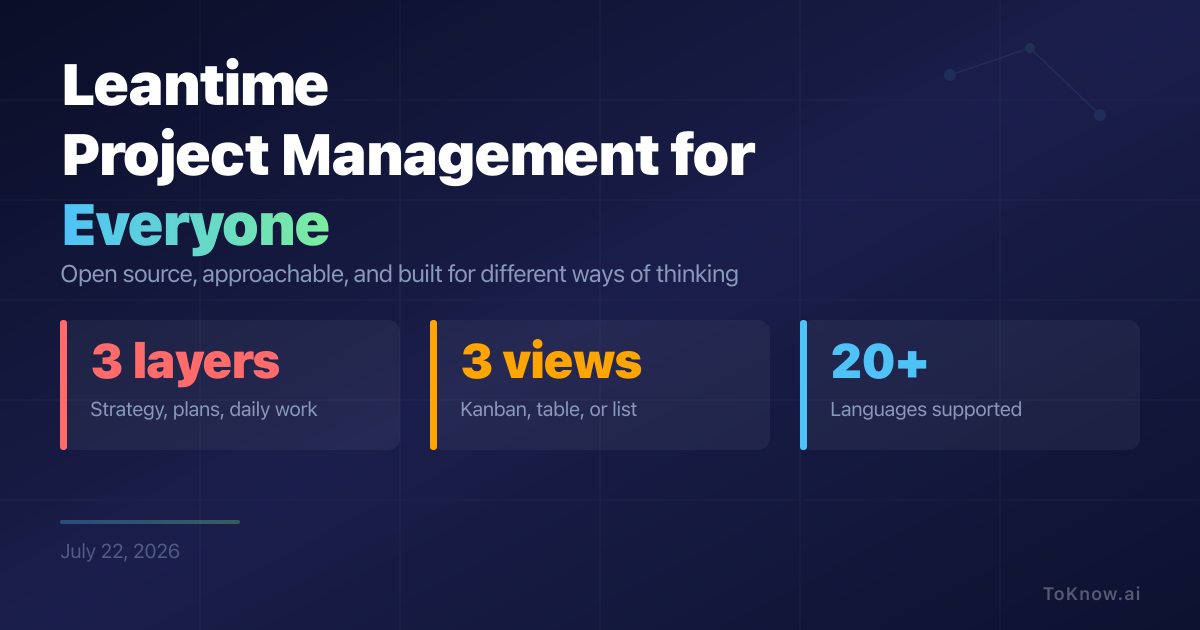
Leantime is an open-source project management system for non-project managers. It puts strategy, planning, and daily execution in one workspace instead of treating projects as task lists. Teams can define goals and metrics, explore ideas with project blueprints and SWOT or risk canvases, plan milestones on a timeline, then run the work through Kanban, table, or list views. The open-source package also includes subtasks, dependencies, sprints, time tracking, reports, documents, retrospectives, role-based permissions, and more than 20 languages. Leantime sits between two familiar extremes. It has Trello’s approachable boards, but adds much of the planning depth people associate with Jira. It is also a self-hostable alternative to ClickUp, Monday, and Asana.
Leantime also pays attention to cognitive load. The project describes itself as built with ADHD, autism, and dyslexia in mind. A personal dashboard gathers work across projects, time boxing places tasks between calendar events, visual boards reduce reliance on long text lists, and emoji ratings help prioritize work by interest. These features may make busy projects easier to read and start, but they do not prove a medical benefit. Leantime has not published an independent controlled study. Teams can use its hosted service or self-host the AGPL-3.0 code, keeping more control over project data and deployment.
Sources:
- Leantime product overview
- Leantime open-source features and installation
- Leantime on project management for ADHD
- Leantime AGPL-3.0 license
Disclaimer: For information only. Accuracy or completeness not guaranteed. Illegal use prohibited. Not professional advice or solicitation. Read more: /terms-of-service
Reuse
Citation
@misc{kabui2026,
  author = {{Kabui, Charles}},
  title = {Leantime: {Project} {Management} for {People} {Who} {Are}
    {Not} {Project} {Managers}},
  date = {2026-07-22},
  url = {https://toknow.ai/posts/leantime-open-source-project-management-neurodiversity/},
  langid = {en-GB}
}