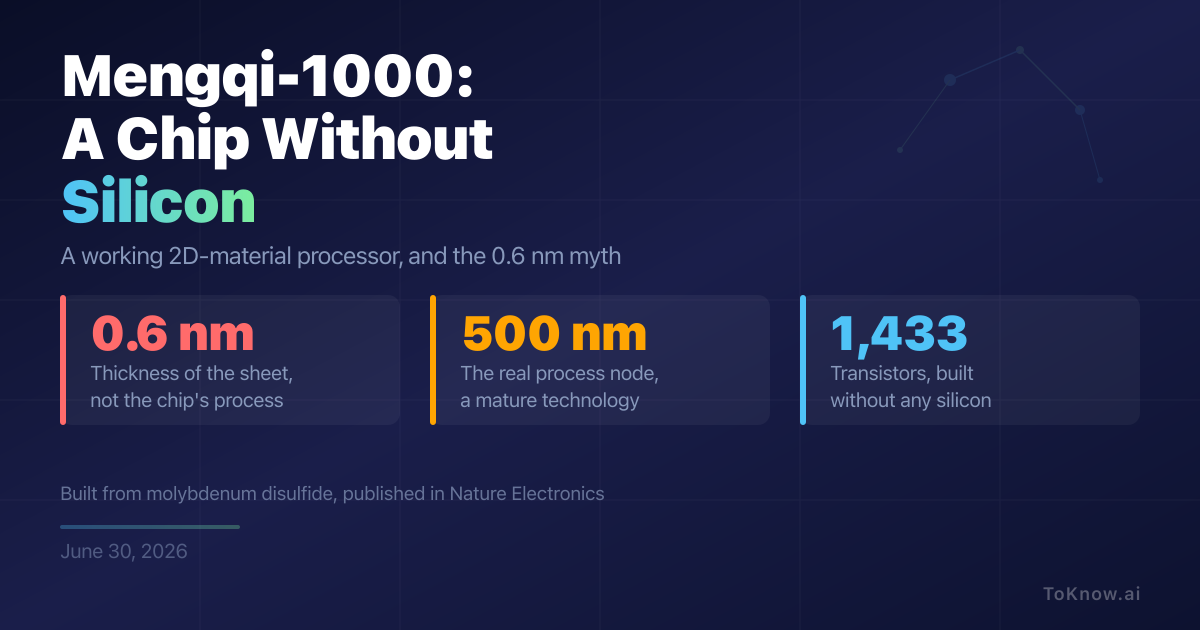
Researchers at Nanjing University, working with Huawei and Suzhou Laboratory, built Mengqi-1000 (“Magic-1000”), a working microprocessor made from molybdenum disulfide instead of silicon. Molybdenum disulfide is a two-dimensional material, a sheet three atoms thick that still carries current cleanly, which silicon cannot do that thin. Published in Nature Electronics on May 26, 2026, it is the first multi-bit parallel processor built from a 2D semiconductor: 1,433 transistors at a record density of about 9,336 per square millimetre, running arithmetic on several bits at once at a 1 kHz clock.
The 0.6 nanometres is the thickness of the molybdenum disulfide sheet, not the size of a transistor or the manufacturing process. The chip was actually made on a 500-nanometre process, more than 800 times larger, and a real 0.6 nm transistor would be just a few atoms wide, beyond what any chipmaking tool can pattern. The South China Morning Post report and the university’s own announcement never use the figure.
The underlying advance is real. As silicon nears its physical size limit, materials that stay stable at atomic thinness are among the few ways left to keep chips improving, and for China the approach sidesteps the chipmaking machines it cannot buy. For perspective, at 1 kHz with 1,433 transistors, Mengqi-1000 is about as complex as 1971’s Intel 4004, the first commercial microprocessor; a Penn State team built a simpler 2D computer in 2025. The genuine achievement got buried under a number the researchers never claimed.
Read More: Huawei’s other route around the same limits, a chip-design trick that targets density without the banned lithography machines.
Sources:
- A bit-parallel molybdenum disulfide computer built through multi-level co-optimization (Nature Electronics)
- Huawei and scientists build 2D parallel computing chip that rewrites Moore’s Law (South China Morning Post)
- Ultra-thin MoS₂ computer packs 1,400 transistors onto one chip (Tech Xplore)
- World’s first non-silicon 2D computer developed (EurekAlert, Penn State)
- Molybdenum disulfide (Wikipedia)
Disclaimer: For information only. Accuracy or completeness not guaranteed. Illegal use prohibited. Not professional advice or solicitation. Read more: /terms-of-service
Reuse
Citation
@misc{kabui2026,
  author = {{Kabui, Charles}},
  title = {Mengqi-1000: {A} {Working} {Chip} {Without} {Silicon,} and
    the “0.6 {Nanometre}” {Myth}},
  date = {2026-06-30},
  url = {https://toknow.ai/posts/mengqi-1000-2d-molybdenum-disulfide-chip-0-6nm-myth/},
  langid = {en-GB}
}