rea-video is an add-on for coding agents such as Claude Code and Codex. Give it a video and it says, shot by shot, how each shot was made: filmed, AI-generated, avatar, 3D render, code-built graphics or screen recording. Small scripts measure clues in the file: the frame-rate pattern (footage made at 24 frames a second and shown at 30 repeats about 20% of frames), camera noise, texture, whether the whole picture slides as one flat sheet, and AI-content labels in the file’s data. For filmed, AI and 3D shots those clues carry less weight, so a vision model such as Gemini (an AI that reads images) mostly decides, and the agent checks shots where the two disagree.
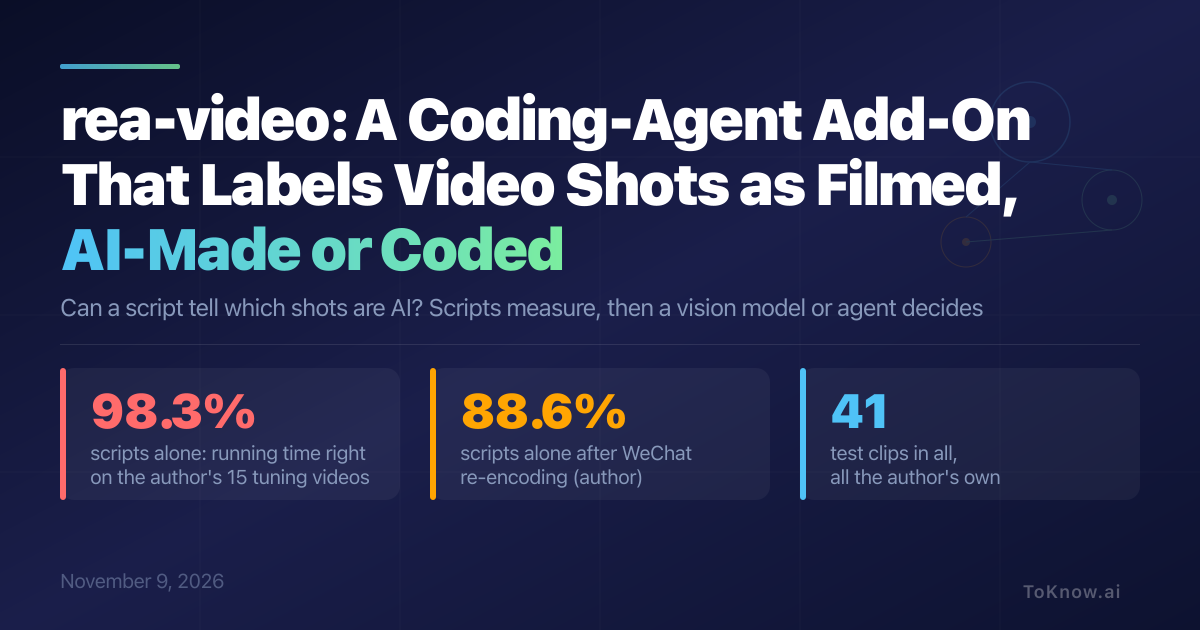
The author reports that the scripts alone label 98.3% of running time correctly on the 15 videos used to tune them, and 99.6% and 98.9% on two small test sets of 9 and 7 videos. On 10 videos that WeChat re-encoded, which wipes out camera noise, they score 88.6%, rising to 99.6% with Gemini and 100% with agent review. Sound-effect detection is no better than chance. An outside write-up notes that all 41 clips are the author’s own.
A video maker copying an ad gets a remake plan that sorts the shots into three piles: ones to film with a camera, ones to make with an AI video tool, and ones to build as graphics in code. rea-video renders nothing, and its author says another tool, Hypit, is faster for a quick lookalike.
Sources:
- rea-video README (GitHub)
- Detection rules, docs/decompose.md (GitHub)
- Evaluation results, eval/RESULTS.md (GitHub)
- rea-video: an agent skill that tells you how any video was made (explainx.ai)
Disclaimer: For information only. Accuracy or completeness not guaranteed. Illegal use prohibited. Not professional advice or solicitation. Read more: /terms-of-service
Reuse
Citation
@misc{kabui2026,
  author = {{Kabui, Charles}},
  title = {Rea-Video: {A} {Coding-Agent} {Add-On} {That} {Labels}
    {Video} {Shots} as {Filmed,} {AI-Made} or {Coded}},
  date = {2026-11-09},
  url = {https://toknow.ai/posts/rea-video-reverse-engineer-video-shot-by-shot-ai-detection/},
  langid = {en-GB}
}