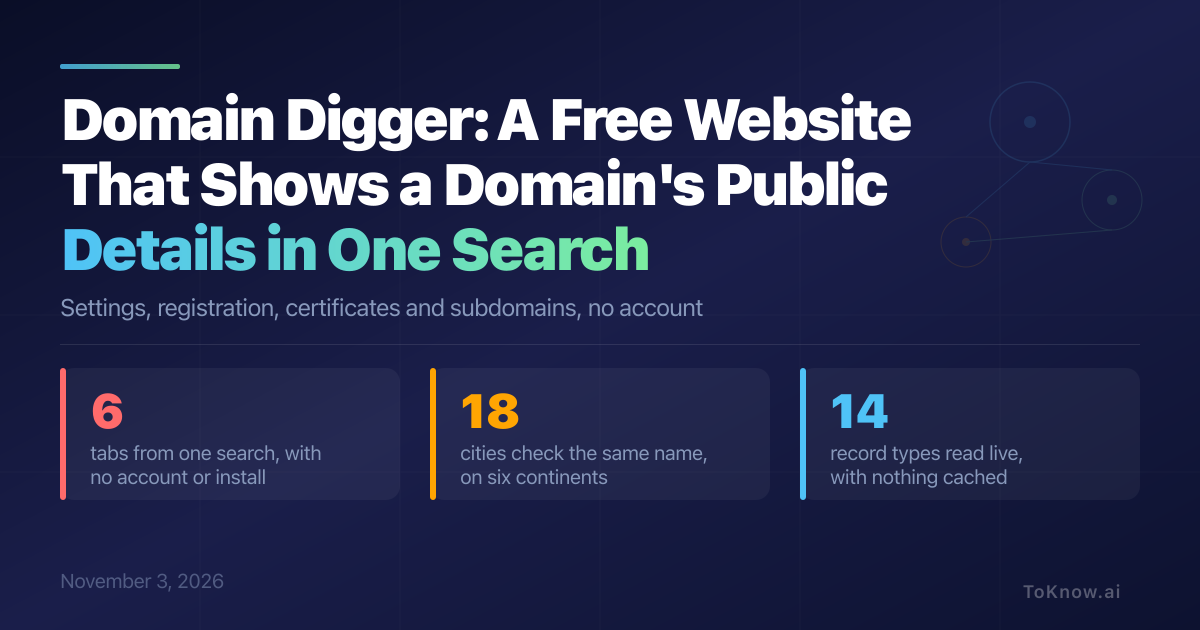
Domain Digger is a free website that shows what the internet publicly records about a domain name, for developers, site owners and security staff. You paste a name, with no account or install, and six tabs open: DNS records (the internet’s address book, which says where a name’s website and email live), a world map of those answers, a check of their digital signatures, WHOIS (the public record of who registered the name and when it expires), every security certificate issued for the name, and its subdomains. It reads 14 record types and can compare the name’s own servers with public ones run by Cloudflare, Google and Alibaba. Click an address to see roughly where its server sits and which company runs the network.
Checking a domain usually takes three separate tools: dig (a terminal command for DNS questions), whois, and a certificate search site such as crt.sh. Domain Digger puts all three in one browser tab, runs every lookup live and gives each result a link you can share. Its map asks the same question from 18 cities on six continents, which shows whether a recent change has reached visitors everywhere. For past settings, paid services such as SecurityTrails keep a history, with plans listed at $500 and $1,500 a month.
Read More: Protecting Against Domain Front-Running by Registrars, on checking if a domain name is free without tipping off a registrar.
Sources:
- Domain Digger lookup for example.com
- Domain Digger source code and README (GitHub)
- Domain Digger’s 18 lookup cities and 14 record types (GitHub)
- SecurityTrails API pricing
- dig, the DNS lookup utility (BIND 9 manual, ISC)
Disclaimer: For information only. Accuracy or completeness not guaranteed. Illegal use prohibited. Not professional advice or solicitation. Read more: /terms-of-service
Reuse
Citation
@misc{kabui2026,
  author = {{Kabui, Charles}},
  title = {Domain {Digger:} {A} {Free} {Website} {That} {Shows} a
    {Domain’s} {Public} {Details} in {One} {Search}},
  date = {2026-11-03},
  url = {https://toknow.ai/posts/domain-digger-open-source-domain-analysis-toolkit/},
  langid = {en-GB}
}