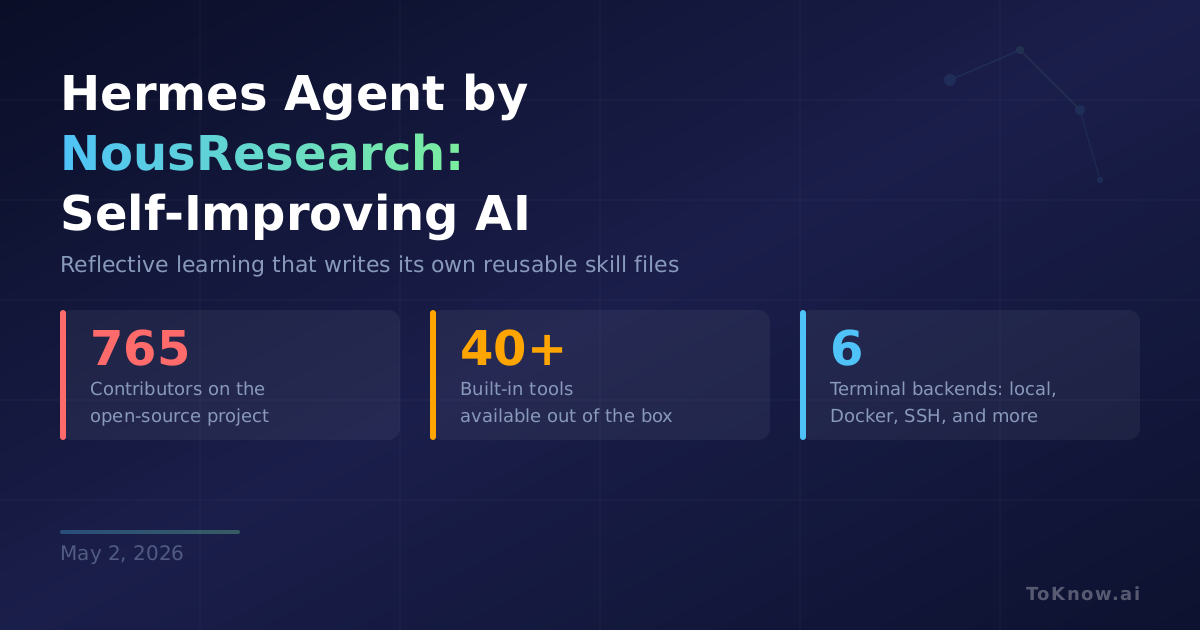
Hermes Agent from Nous Research is a self-improving AI agent built in Python. Available at github.com/NousResearch/hermes-agent with 765 contributors and at version v0.12.0, its core innovation is a “Reflective Phase” that runs after every task. During this phase, the agent analyzes its own performance, identifies what worked and what failed, then writes reusable SKILL.md files automatically for future reference. Memory uses SQLite in an opaque, AI-optimized format, a sharp contrast to OpenClaw’s human-readable Markdown approach.
The agent supports messaging across Telegram, Discord, Slack, WhatsApp, and Signal. For users switching from OpenClaw, a migration tool (hermes claw migrate) imports existing configurations directly. Model choice is flexible: Nous Portal, OpenRouter, NVIDIA NIM, Xiaomi MiMo, and others all work. Under the hood, Hermes supports six terminal backends (local, Docker, SSH, Daytona, Singularity, and Modal) with over 40 built-in tools available out of the box.
The fundamental architectural difference between Hermes and OpenClaw comes down to “agent-first” versus “gateway-first” design. OpenClaw treats messaging orchestration as primary, while Hermes treats task execution and learning as primary. Many users run both: OpenClaw handles messaging routing, and Hermes handles complex tasks that benefit from accumulated learning. The combination suggests that the AI agent space is splitting into specialized layers rather than converging on a single tool.
Sources:
Disclaimer: For information only. Accuracy or completeness not guaranteed. Illegal use prohibited. Not professional advice or solicitation. Read more: /terms-of-service
Reuse
Citation
@misc{kabui2026,
  author = {{Kabui, Charles}},
  title = {Hermes {Agent} by {NousResearch:} {Self-Improving} {AI}
    {Through} {Reflective} {Learning}},
  date = {2026-05-02},
  url = {https://toknow.ai/posts/hermes-agent-nousresearch-self-improving-reflective-learning/},
  langid = {en-GB}
}