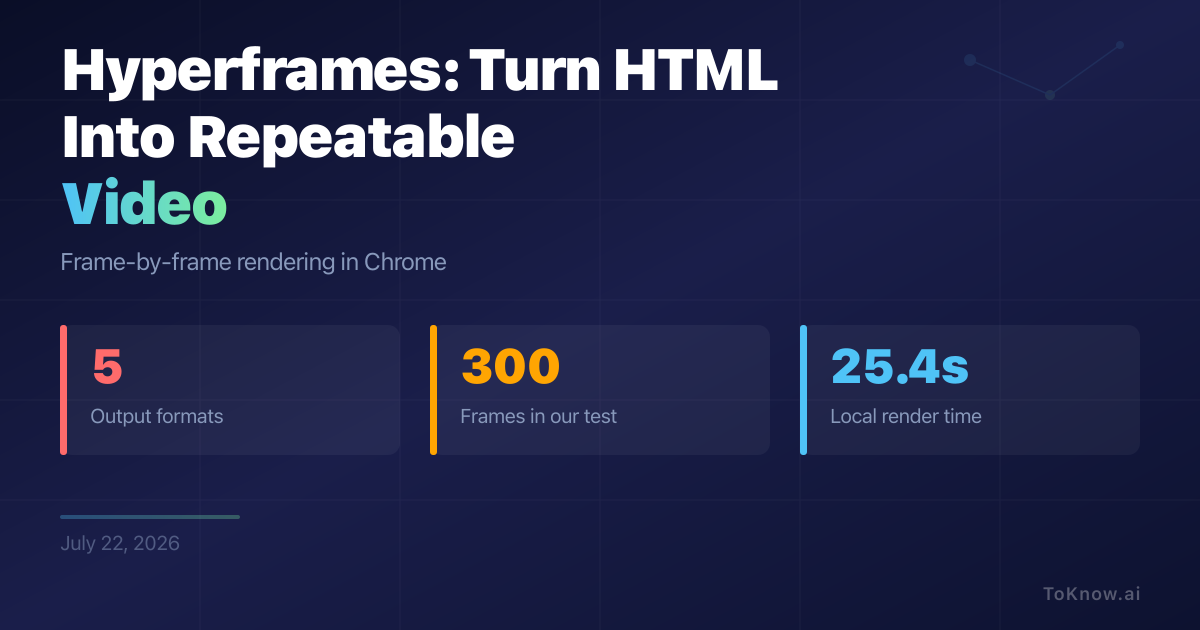
HeyGen released Hyperframes 0.7.68 on July 22, a bug-fix update for looping clips and nested CSS rather than a new launch. Hyperframes describes a video with ordinary HTML, CSS, media elements, and timing attributes. Its engine calculates the time for each frame, seeks animations such as GSAP or Lottie to that moment, captures the page in headless Chrome, then hands the frames and audio to FFmpeg. Version 0.7.68 requires Node.js 22 or newer and can export MP4, MOV, WebM, GIF, or PNG sequences at 1 to 240 frames per second. In local test, six browser workers rendered a blank 10-second, 1080p composition at 30fps: 300 frames became a 25.6KB MP4 in 25.4 seconds.
A developer can turn data into a chart, product update, or personalized clip and rerender it without dragging layers around a timeline. The text source and command-line interface also make Hyperframes easier for coding agents to edit than a proprietary project file. This is a narrower job than the full production pipeline in OpenMontage. Repeatability still takes discipline. The determinism rules ban unseeded randomness, wall-clock timers, and network requests during rendering. Local fonts and Chrome versions can also change pixels, so the rendering guide recommends Docker when exact output matters. A composition can run JavaScript, so treat an unknown project as code, not as a harmless video file.
Sources:
- Hyperframes introduction
- Deterministic rendering
- Rendering formats and options
- Hyperframes v0.7.68 release
- Hyperframes CLI package metadata
Disclaimer: For information only. Accuracy or completeness not guaranteed. Illegal use prohibited. Not professional advice or solicitation. Read more: /terms-of-service
Reuse
Citation
@misc{kabui2026,
  author = {{Kabui, Charles}},
  title = {Hyperframes: {Turn} {HTML} {Into} {Repeatable} {Video}},
  date = {2026-07-22},
  url = {https://toknow.ai/posts/hyperframes-html-repeatable-video/},
  langid = {en-GB}
}