OpenAI published its plan on October 5 for marking AI-written text, as the EU AI Act requires, so other systems can identify it. The mark is a watermark called textGrain: an invisible pattern in the model’s word choices that only a secret key can find. Because the pattern sits in the words, it survives copy and paste. API developers worldwide can opt in now, and it stays off unless they ask. OpenAI said eligible ChatGPT and Codex output in the EU would get the mark within weeks. The detector stays private, and OpenAI approves researchers and expert organisations one case at a time.
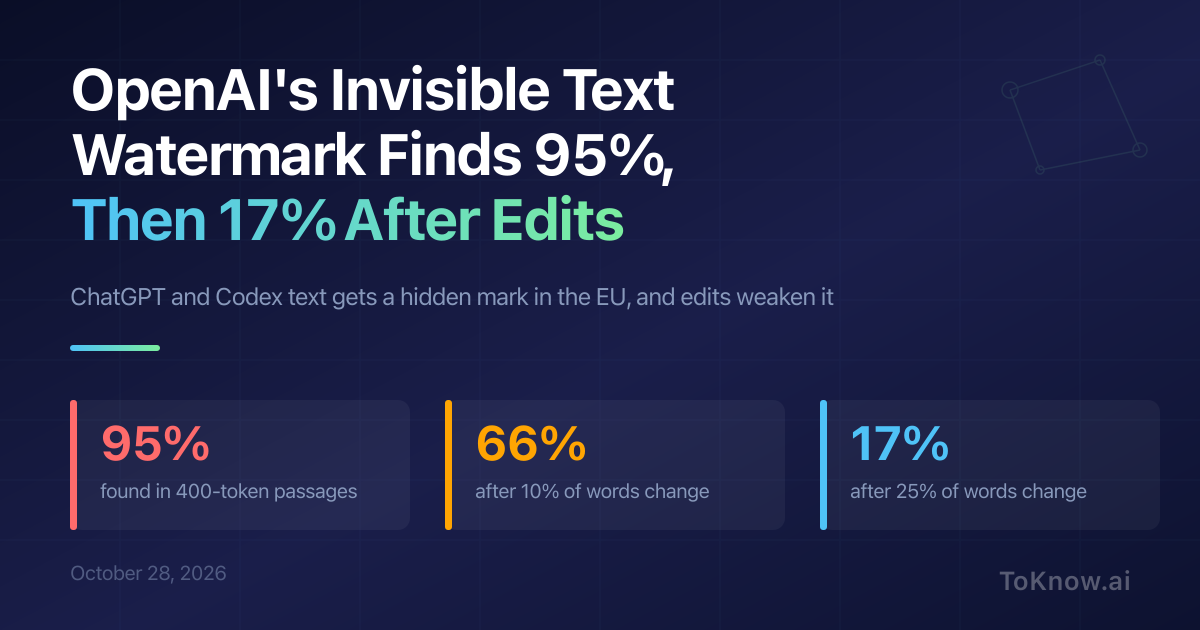
Detection improves with length. At a 1% false-alarm rate, the detector found the mark in about 95% of 400-token passages (roughly 300 words) answering psychology questions. At half that length the rate was about 80%. Mathematics scored far lower, because there are fewer ways to word the same answer. Editing does more damage: in 400-token passages, swapping 10% of words for synonyms dropped detection from about 92% to 66%, and 25% dropped it to 17%. Anyone can upload an image or audio file to OpenAI’s Verify tool. For text there is no public equivalent at launch.
Anthropic said in August it would watermark Claude text worldwide, using Google’s SynthID for text. OpenAI reports textGrain matched or exceeded SynthID. It also reports no meaningful change on its coding-agent tests with the mark on: DeepSWE moved from 72.80% to 71.68% and Terminal-Bench from 53.90% to 56.06%.
Read More: The EU AI Act also requires chatbots to say they are machines
Sources:
- Our approach to EU text provenance rules
- textGrain: Entropy-Calibrated Watermarking for Language Model Text (technical report, PDF)
- TechCrunch: OpenAI will start watermarking ChatGPT’s text in the EU
- The Verge: OpenAI is adding text watermarking in ChatGPT and Codex
- European Commission: Code of Practice on Transparency of AI-generated Content
Disclaimer: For information only. Accuracy or completeness not guaranteed. Illegal use prohibited. Not professional advice or solicitation. Read more: /terms-of-service
Reuse
Citation
@misc{kabui2026,
  author = {{Kabui, Charles}},
  title = {OpenAI’s {Invisible} {Text} {Watermark} {Finds} 95\% of
    {Long} {Passages,} 17\% {After} {Edits}},
  date = {2026-10-28},
  url = {https://toknow.ai/posts/openai-textgrain-text-watermarking-eu-ai-act/},
  langid = {en-GB}
}