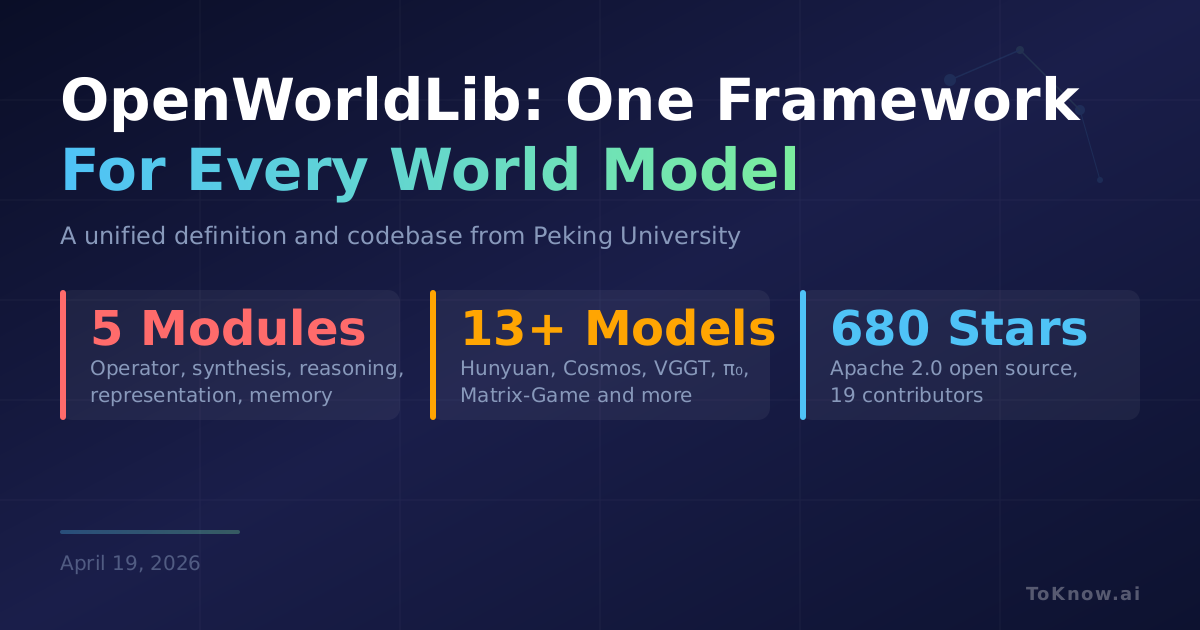
The Peking University DataFlow team released OpenWorldLib, a unified codebase and a sharper definition for what a “world model” actually is. The term has been used for everything from next-frame video predictors to robot policies, which makes fair comparison nearly impossible. The paper proposes a single working definition: a world model is a system centered on perception, equipped with interaction and long-term memory, that understands and predicts a complex world. The framework breaks that into five modules: an operator that handles input and interaction signals, a synthesis module for video, 3D, and robot actions, a reasoning module for spatial and multimodal reasoning, a representation module for 3D structure, and a memory module for long-horizon context. The GitHub repository ships under Apache 2.0 and already integrates 13 systems including Matrix-Game-2, Hunyuan-WorldPlay, Cosmos-Predict-2.5, WoW, VGGT, and the π₀ and π₀.₅ vision-language-action models, with 680 stars at the time of writing.
For anyone building or evaluating world models, this removes a real source of friction. Instead of cloning a different repo for each method and writing custom glue code to compare interactive video generation against 3D scene reconstruction or robot action prediction, you load a shared pipeline and call standardized methods. The paper’s evaluation across these systems also surfaces a useful state-of-the-art map: Hunyuan-WorldPlay leads on visual quality for interactive video, VGGT can build 3D scenes but drifts geometrically under large camera motion, and π₀.₅ generalizes well across robot tasks but long-horizon physical consistency remains an open problem across the board.
The bigger shift is that world model research is starting to look less like one-off papers and more like a stack with shared interfaces. Once memory, perception, and action generation can be swapped independently, progress can compound across labs instead of restarting at each release.
Read More: Trinity of Consistency: a framework for measuring general world models
Sources:
- OpenWorldLib: A Unified Codebase and Definition of Advanced World Models (arXiv)
- OpenWorldLib GitHub repository
- OpenWorldLib HTML paper
- DataFlow project (parent codebase)
Disclaimer: For information only. Accuracy or completeness not guaranteed. Illegal use prohibited. Not professional advice or solicitation. Read more: /terms-of-service
Reuse
Citation
@misc{kabui2026,
  author = {{Kabui, Charles}},
  title = {OpenWorldLib: {One} {Framework} to {Define} and {Run} {Every}
    {World} {Model}},
  date = {2026-04-19},
  url = {https://toknow.ai/posts/openworldlib-unified-definition-world-models-framework/},
  langid = {en-GB}
}