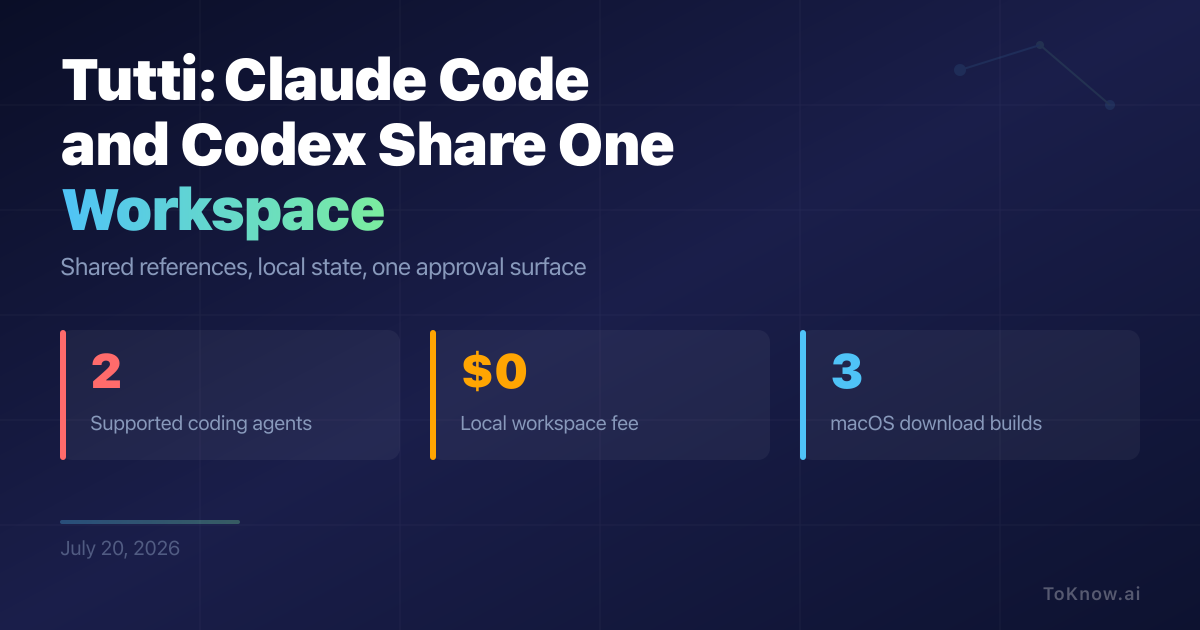
Tutti puts Claude Code and Codex into one local desktop workspace, where either agent can reference past conversations, files, tasks, app outputs, and the other agent with @. That is not a merged memory: the user selects what to attach, and Tutti resolves each reference when an agent runs. The open-source v0.2.1 desktop release supports two agents today, Claude Code and Codex, with OpenClaw and Hermes still in development. It ships three macOS downloads for Apple Silicon, Intel, and universal machines; Windows support and the multi-user Tutti VM remain future work. The July 16 release fixed unacknowledged messages, long-context blocking, and session-lifecycle problems, useful warnings that this is still early software.
For one developer who uses both subscriptions, the local app is free and keeps its working state under ~/.tutti, including a SQLite database, logs, agent sessions, and attachments. That can remove the repeated job of copying Claude’s plan into Codex before implementation. Unlike CC Switch, which mainly manages agent tools and providers, Tutti focuses on passing work between active sessions. The tradeoff is concentrated access: one workspace can surface local files, conversations, command approvals, and app output to multiple agents. Its security policy explicitly covers unintended exposure of files, credentials, session data, and workspace state. Keep approvals narrow and treat cross-agent references as shared trust, not automatic safety.
Sources:
- Tutti v0.2.1 README
- Tutti v0.2.1 release notes
- Tutti pricing
- Tutti local state storage
- Tutti security policy
Disclaimer: For information only. Accuracy or completeness not guaranteed. Illegal use prohibited. Not professional advice or solicitation. Read more: /terms-of-service
Reuse
Citation
@misc{kabui2026,
  author = {{Kabui, Charles}},
  title = {Tutti: {Claude} {Code} and {Codex} {Share} {One} {Workspace}},
  date = {2026-07-20},
  url = {https://toknow.ai/posts/tutti-shared-workspace-claude-code-codex/},
  langid = {en-GB}
}